
Who's the Quarterback? Identifying and Building Your Community Lead Entity
Introduction: The Moment Everything Changed
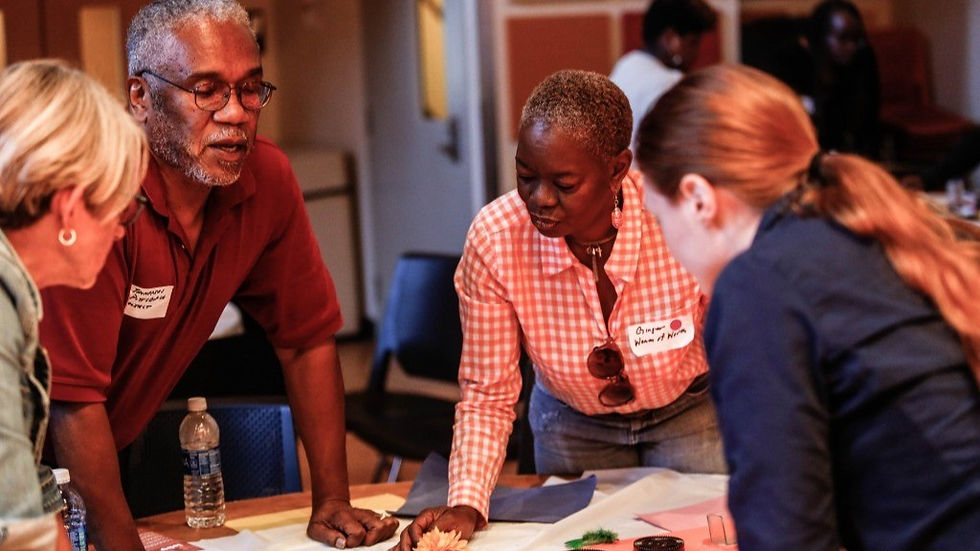
The fellowship hall was too small for the crowd that Tuesday evening. Thirty-some people wedged into folding chairs, fanning themselves with meeting agendas while a window unit air conditioner wheezed against the summer heat. Around the cramped space sat representatives from a housing nonprofit, the local school district, a health clinic, an economic development corporation, and a handful of community residents who'd taken time off work to be there.
Everyone had come with good intentions. Everyone had a plan. And absolutely no one was on the same page.
The housing nonprofit had just secured funding to build affordable units on three vacant lots. The school district was launching a new early childhood initiative. The health clinic wanted to expand services. The economic development folks were recruiting businesses to open storefronts. Each presentation was polished, each plan well-conceived. But as I sat there listening, a troubling pattern emerged: these efforts weren't just uncoordinated—they were sometimes working at cross-purposes.
The affordable housing would be built on lots that the economic development team had been courting a grocery store to purchase. The school district's new program would pull resources from the neighborhood-serving elementary school that was already struggling. The health clinic's expansion would require parking that didn't exist without displacing a community gathering space.
When a resident—a grandmother who'd lived in the neighborhood for forty years—finally raised her hand, her question cut through all the polish: "Who's in charge of making sure all this actually helps us instead of just creating more problems?"
The room fell silent. Representatives looked at each other. Someone mumbled something about "collaboration." Another mentioned a steering committee that met quarterly. But the truth hung in the air, unavoidable: Nobody was actually in charge of the whole picture. Everyone was running their own play, and the community was left trying to make sense of the chaos.
If this were a football team, I remember thinking, we'd be running plays without a quarterback.
That moment—replicated in countless community meetings across countless neighborhoods—reveals a fundamental truth about why neighborhood transformation efforts so often fall short. It's not for lack of talented people. It's not even for lack of resources, though those are always stretched thin. It's because we're trying to orchestrate comprehensive change without the infrastructure that makes orchestration possible.
We're trying to transform neighborhoods without anyone calling the plays.
This matters profoundly for everyone working toward community transformation. For funders, your carefully considered investments may be undermining each other without a quarterback to ensure they work in concert. For government leaders, your well-intentioned departmental initiatives may be working at cross-purposes without integrated leadership on the ground. For community development professionals, you may be exhausting yourselves running program after program without the structural foundation that makes lasting change possible.
The question "Who's your community quarterback?" isn't academic. It's existential. Because here's what nearly three decades of lived experience in neighborhood development has taught me: comprehensive transformation doesn't happen by accident. It doesn't emerge spontaneously from good intentions and hard work. It requires someone—some entity—that can hold the whole picture, coordinate the players, adapt strategy in real-time, and maintain focus on long-term goals while managing immediate needs.
This article explores that critical but often overlooked question: Who's your community quarterback? More importantly—do you need to build one from scratch, strengthen an existing organization, or fundamentally rethink how your neighborhood's transformation is being led?
Why Community Quarterbacks Are Almost Always Essential
Let me take you back to a different meeting, years later, in a different neighborhood. Same kinds of stakeholders around the table—housing developers, school administrators, health providers, small business advocates, residents, and funders. But this gathering felt fundamentally different.
When the housing developer presented plans for new mixed-income units, the school representative immediately spoke up—not to object, but to share how the district was planning to strengthen the neighborhood-serving school specifically to attract and retain the families those units would house. The health provider detailed how they were expanding clinic hours to align with the work schedules of residents in the new development. The small business advocate described how they were coordinating workforce training programs to create pathways to the jobs being created by neighborhood investment.
It wasn't magic. It was quarterbacking.
A trusted, place-based organization had spent years building the relationships, earning the credibility, and developing the capacity to coordinate these efforts. They didn't deliver all the services themselves. They didn't control everyone's budget. But they held the comprehensive vision. They facilitated the alignment. They ensured that each player understood not just their own role, but how their work connected to everyone else's.
The difference between these two meetings—between fragmentation and integration—is the difference between neighborhoods that inch forward and neighborhoods that transform.
The Coordination Challenge Nobody Wants to Talk About
Here's an uncomfortable truth: the way we've organized the community development field almost guarantees fragmentation.
Think about how funding flows into neighborhoods. Housing dollars come through one stream with specific requirements and timelines. Education funding comes through completely different channels with entirely different accountability measures. Health investments follow their own logic. Economic development has separate priorities. Each funding source—whether government, foundation, or private—has its own application process, reporting requirements, and definition of success.
Now layer on top of that the organizational landscape. You have housing developers focused on units built and occupancy rates. You have school administrators measured on test scores and graduation rates. You have health providers tracking patient visits and health outcomes. You have economic development entities counting jobs created and businesses opened.
Each organization is doing exactly what it's designed to do, pursuing exactly what it's funded to pursue. And yet the net result is often a patchwork of well-intended efforts that don't add up to transformation because nobody is responsible for ensuring they add up to anything at all.
I've watched this play out in painful ways. A neighborhood finally secured significant investment in affordable housing, only to see the new units accelerate gentrification because there was no coordinated anti-displacement strategy. Another community celebrated a new charter school opening, not realizing it would pull resources and families from the neighborhood-serving school, ultimately weakening the very neighborhood fabric they were trying to strengthen. A third saw multiple youth programs launch simultaneously, with kids being double-counted in success metrics while others fell through gaps between programs because no one was tracking who was actually being served.
These aren't failures of individual organizations. They're failures of systems. And they're predictable failures when there's no quarterback.
What Makes a Quarterback Different
This is where we need to be precise, because the term "community quarterback" can mean different things to different people. Let me be clear about what I'm talking about.
A community quarterback is not just another service provider. Service organizations focus on their domain—building housing, running after-school programs, providing health care, training workers. They need depth in their area of expertise. A quarterback needs breadth across multiple domains.
A quarterback is not just an advocacy organization. Advocates push for policy changes, shine light on injustice, mobilize community voice. This work is essential. But quarterbacking requires moving beyond advocacy to coordination and execution.
A quarterback is not simply a coalition. Coalitions convene stakeholders, facilitate dialogue, build alignment. But most coalitions lack the capacity to move from planning to implementation, from shared vision to coordinated action.
A community quarterback does something distinct: they hold the holistic vision of neighborhood transformation, they coordinate work across multiple systems, and they have both the convening power to bring stakeholders together and the execution capacity to ensure plans become reality.
The quarterback touches the ball on every play not because they're the star, but because they're the position that connects everyone else's work into a coherent strategy.
The Strategic Question: Build New or Strengthen Existing?
One of the most consequential decisions communities and funders face is whether to build a new quarterback organization from scratch or invest in strengthening an existing entity to take on this role. I've seen both paths work—and I've seen both paths fail when the decision wasn't grounded in honest assessment.
In one community, grassroots organizing had been happening for years around kitchen tables and in church basements. Residents had built deep trust, identified shared priorities, and mobilized for small wins. But when significant funding became available for comprehensive revitalization, there was no formal entity capable of receiving and deploying those resources. The choice to build new—to incorporate as a formal organization while maintaining grassroots authenticity—was the right call. It took five years, immense patience from funders, and constant attention to keeping community voice central. But the result was a quarterback that had both legitimacy and capacity.
In another place, a well-established community development corporation had deep roots and a strong track record in affordable housing. When the opportunity arose to lead comprehensive transformation, they made the strategic decision to evolve—to expand from single-sector expertise to multi-sector coordination. They brought on new staff with different competencies, restructured their governance to include broader representation, and shifted their identity from housing developer to community quarterback. The transition was rocky at times, but it leveraged existing trust and relationships that would have taken years to build from scratch.
Both paths required similar elements to succeed: patient capital willing to fund coordination functions, not just programs; leadership committed to authentic community engagement; honest assessment of organizational capacity and readiness; and willingness to adapt based on what was learned.
The decision between building new and strengthening existing isn't about which approach is universally better. It's about what your specific community context demands. Who currently has the deepest community trust? What organizational capacity already exists? Is there an entity that could evolve into this role, or would that evolution require such fundamental transformation that building new makes more sense? Are there historical dynamics that make certain organizations unsuited for the quarterback role, regardless of their competence?
These questions require uncomfortable honesty. I've watched well-intentioned funders push for building new when strengthening existing would have worked better, simply because they wanted a "fresh start." I've also seen communities try to force-fit existing organizations into quarterback roles they weren't suited for, wasting years and resources before finally acknowledging the mismatch.
The Path Forward
Here's what I've learned about developing quarterback capacity, whether building new or strengthening existing: it takes longer than anyone wants and requires different investment than most funders are comfortable providing.
Quarterback organizations don't emerge fully formed. They develop through stages—first establishing legitimacy with multiple constituencies, then building cross-sector partnerships, then coordinating significant initiatives, then demonstrating measurable impact, then sustaining long-term transformation through leadership transitions and changing conditions.
This developmental arc takes a decade or more. Yet most funding operates on three-year cycles. Most government administrations change every four years. Most organizational strategic plans look five years ahead at most.
The disconnect between the timeline required and the timeline funders and partners are comfortable committing to creates constant instability. I've watched promising quarterback organizations struggle not because they lacked competence or vision, but because they couldn't secure the multi-year general operating support needed to build the infrastructure that makes coordination possible.
What quarterback development actually requires:
From funders: Pool resources for comprehensive, long-term investment. Fund the backbone work that doesn't produce immediate visible outcomes—the relationship building, the strategic planning, the data infrastructure, the coordination functions. Provide flexible capital that can adapt as strategy evolves based on learning.
From government: Create policy environments that enable coordination. Participate as partner, not just funder. Align multiple departmental resources around shared goals. Be willing to be coordinated instead of always needing to control.
From existing organizations: Embrace coordination rather than competing for turf. Share data and align strategies. Recognize the quarterback's unique role without seeing it as diminishing your own importance.
From community members: Hold quarterbacks accountable to community vision. Participate in governance and leadership development. Provide honest feedback about what's working and what isn't.
The Question That Defines Everything
Return with me to that cramped fellowship hall where the grandmother asked, "Who's in charge of making sure all this actually helps us?"
That question cuts to the heart of everything. Not "What programs are you running?" Not "How much money are you spending?" But "Who's ensuring this adds up to something that actually transforms our lives?"
Too many neighborhoods are trying to transform without the fundamental infrastructure that makes transformation possible. We're asking residents to believe in change while the organizational landscape ensures fragmentation. We're investing significant resources while leaving the coordination function to chance—or worse, to whoever has time in their already-overloaded schedule.
The question "Who's your community quarterback?" is really asking: Are we set up for lasting transformation, or just managing programs? It forces honest conversation about structure, not just strategy. About infrastructure, not just initiatives. About the long-term conditions for change, not just immediate interventions.
If you're a funder: Stop funding programs in isolation. Start investing in the quarterback capacity that makes those programs add up to something transformative. Ask not just "What are you doing?" but "Who's coordinating all of this, and how are we supporting that function?"
If you're a government leader: Recognize that your departmental silos are undermining your good intentions. Find or fund the quarterback that can coordinate your various investments. Be willing to be coordinated instead of always needing to control.
If you're a community development professional: Get honest about whether your organization is trying to do too much without the capacity to quarterback effectively. Consider whether supporting the development of quarterback capacity—even if it's not you—might be the highest-leverage work you can do.
If you're a community leader: Demand the infrastructure that makes lasting change possible. Don't settle for piecemeal programs. Insist on coordination. Hold everyone accountable to the vision you set.
Because here's what decades of experience has taught: Neighborhoods don't transform by accident. They transform when there's coordinating intelligence, when there's adaptive leadership, when someone is holding the whole picture and calling plays everyone can run together.
They transform when there's a quarterback.


